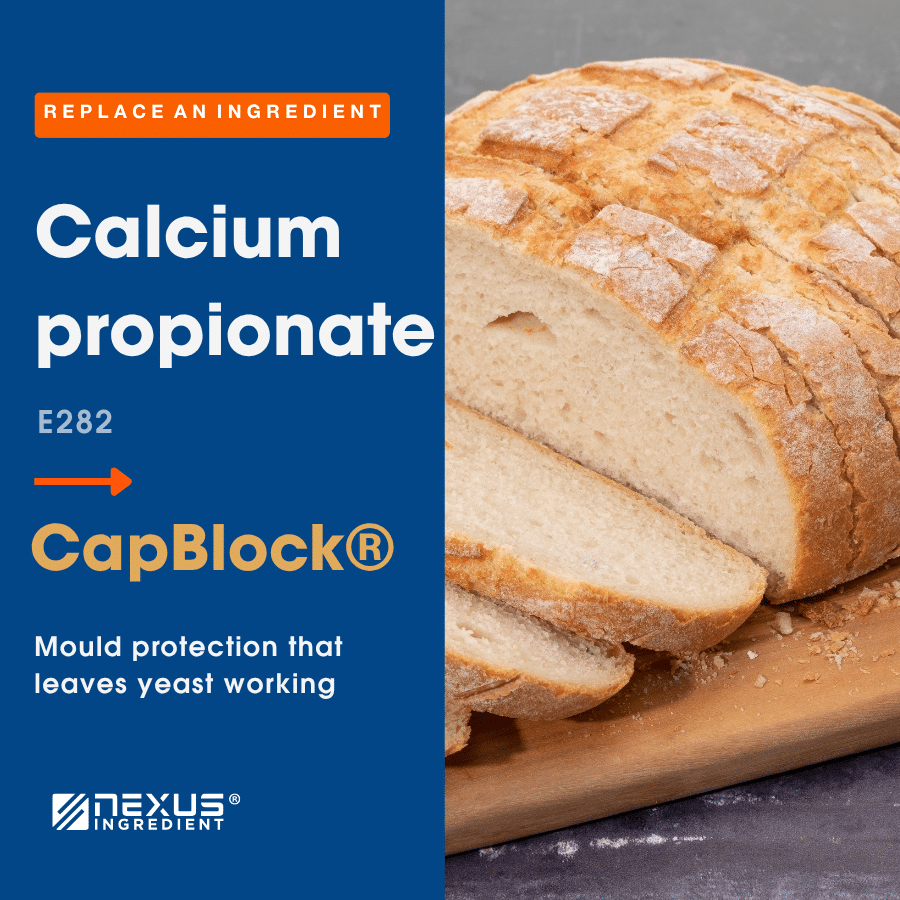
Calcium propionate (E282) is the default mould inhibitor in bread, rolls and many other baked goods. It works, but it is one of the first additives shoppers notice on a bakery label. If you need a calcium propionate replacement that protects shelf life without touching yeast activity, CapBlock® Cultured Brown Rice and CapBlock® Cultured Dextrose are both designed for exactly that job.
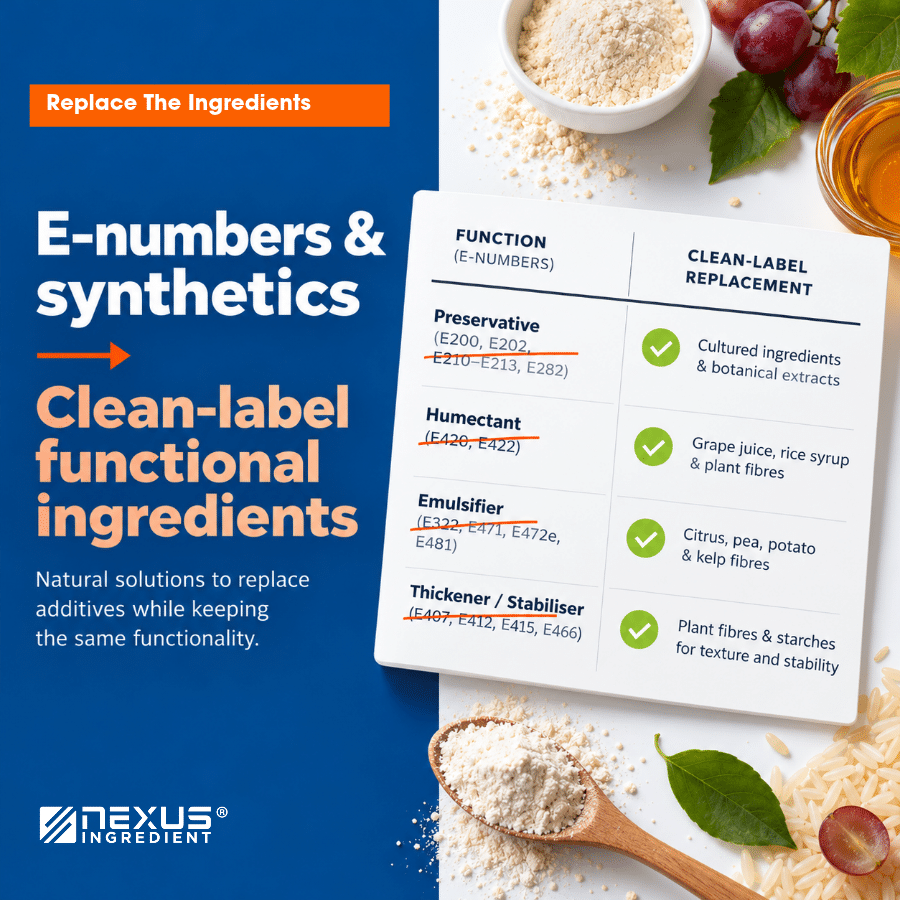
This is part 6 of our Replace an Ingredient series. New to the series? Start with our guide on how to replace E-numbers, or read part 2 on replacing potassium sorbate.
What calcium propionate does, and why bakers want it out
Calcium propionate slows mould growth, which is the main reason most breads go to waste. It is listed as E282 in the UK Food Standards Agency’s approved additives and E numbers, and as code 282 in Australia and New Zealand (Food Standards Code Schedule 8).
The difficulty in a bakery is that the replacement must stop mould without stopping the baker’s yeast. A preservative that slows fermentation changes proof times, volume and crumb. Both CapBlock® grades below are formulated to leave yeast active in yeast-raised baked goods. Learn more about natural preservatives and shelf life extension.
CapBlock® Cultured Brown Rice
CapBlock® Cultured Brown Rice is produced by fermenting brown rice with selected non-GMO organisms and starter cultures. Fermentation generates organic acids and natural metabolites that inhibit mould, some yeasts and some gram-negative bacteria, without affecting yeast-raised baked goods.
- Dosage: 0.5% to 1.5% based on flour weight.
- Works best: at pH 6.0 or less, with pH 4.5 or below ideal.
- Label: Cultured Brown Rice Powder, Brown Rice Powder or Rice Powder.
- Format: off-white, free-flowing powder that is soluble in water.
- Also used in: processed cheeses, smallgoods, dressings, sauces and dips.
CapBlock® Cultured Dextrose
CapBlock® Cultured Dextrose is made by controlled sterile fermentation using proprietary non-GMO organisms. It inhibits mould and bacteria while leaving yeast active, and it also acts as a natural flavouring agent, enhancing the flavour of yeast-raised baked goods.
- Dosage: 0.5% to 2.0%.
- Label: Cultured Dextrose or Natural Flavour, depending on your market.
- Format: off-white powder that is soluble in water.
- Also used in: processed cheese, dairy spreads, meat and poultry products, sauces, salad dressings and dips.
Calcium propionate replacement: side by side
| CapBlock® Cultured Brown Rice | CapBlock® Cultured Dextrose | |
|---|---|---|
| Made from | Fermented brown rice | Fermented dextrose |
| Inhibits | Mould, some yeasts, some gram-negative bacteria | Mould and bacteria |
| Effect on baker’s yeast | Leaves yeast-raised goods unaffected | Leaves yeast active |
| Dosage | 0.5–1.5% of flour weight | 0.5–2.0% |
| Label options | Cultured Brown Rice Powder · Brown Rice Powder · Rice Powder | Cultured Dextrose · Natural Flavour |
| Extra benefit | Declares as a rice powder | Enhances flavour in yeast-raised goods |
| Shelf life | 24 months | 24 months |
Which one should you trial?
- You want the label to read like a grain: start with CapBlock® Cultured Brown Rice. “Rice Powder” sits naturally in a bread ingredient list.
- Your product is lower in acidity: check the pH first. Cultured Brown Rice performs best at pH 4.5 or below and needs pH 6.0 or less.
- You want a flavour lift as well as protection: start with CapBlock® Cultured Dextrose.
- You also need to replace potassium sorbate: both grades are designed as clean-label replacements for potassium sorbate as well as calcium propionate. Our potassium sorbate post compares the full CapBlock® line-up.
Shelf life depends on your recipe, process, packaging and storage, so run a side-by-side trial against your current formulation before switching. Gluten-free bakers can see our gluten-free baked goods and gluten-free breads pages, and the full CapBlock® range covers liquid and powder options.
Frequently asked questions
Will CapBlock® slow my dough’s proof?
Both grades are formulated to leave yeast active in yeast-raised baked goods, so they suit breads, rolls and other fermented bakery products. Confirm proof times and volume in your own trial.
How do I calculate the dosage?
For baked goods, CapBlock® Cultured Brown Rice is dosed at 0.5–1.5% of flour weight. For meat, sauces and other foods, calculate on total product weight. Our technical team can advise on the right starting point for your application.
How will it appear on my ingredient list?
Cultured Brown Rice can be declared as Cultured Brown Rice Powder, Brown Rice Powder or Rice Powder. Cultured Dextrose can be declared as Cultured Dextrose or Natural Flavour. Confirm the right declaration for your market with your regulatory team.
Ready to start? Find more preservative replacements in our Ingredient Replacement Finder, or request a sample to begin your trial. You can also contact our team at info@nexusingredient.com.